
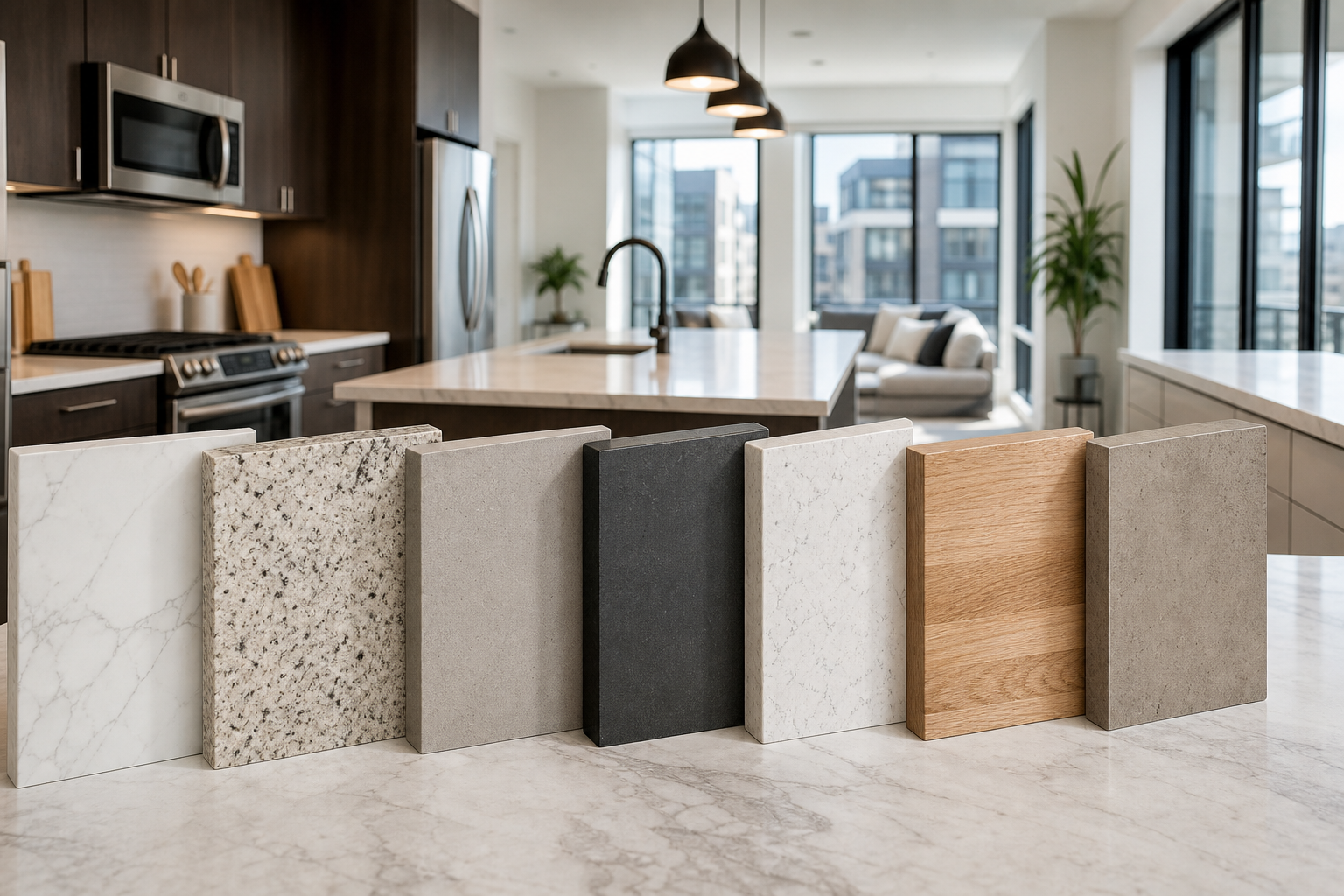

Countertop material comparison for apartment and multi-unit kitchens
This countertop material comparison is written for property managers, landlords, and apartment owners who need a clear, criteria-led way to choose kitchen surfaces that reduce downtime and long-term maintenance. Below I compare common materials by durability, maintenance, stain resistance, repairability, installation disruption, and tenant appeal. Materials covered: laminate, quartz, granite, solid surface, butcher block, stainless steel, and tile.
Why these decision criteria matter
Durability
Durability drives replacement cycles and long-term cost. For rental units, choose surfaces that resist scratches, chips, and heat where tenants will not treat the space gently. Durable materials lower the frequency of full replacements and reduce vacancy time during renovations.
Maintenance time and cost
Maintenance affects how fast a unit can be turned over. Some countertops need daily care, others need periodic sealing or professional cleaning. Faster, lower-cost maintenance shortens timelines between tenants and reduces management hours.
Stain resistance and repairability
Stain resistance affects whether you can fix an issue in-house or need full replacement. Repairability matters when you must patch damage quickly to list a unit. When repairs are simple, you can avoid long vacancies and repeated mobilization costs.
Installation time and disruption
Installation time influences whether work can be done in occupied units and how many units you can schedule per week. Materials with quick turnaround are useful for high-turnover buildings. For larger or premium installs, longer windows may be acceptable if the finished value justifies it.
Appearance and tenant appeal
Appearance affects marketability and the rent you can charge. Some materials deliver a premium look that attracts long-term tenants, while others provide a neutral, durable finish that hides wear between turnovers.
What this comparison does and does not cover
This comparison focuses on practical performance and suitability for multi-unit rental settings rather than bespoke design choices or exact installation pricing. For general product overviews consult Home Depot or This Old House for wider consumer guidance and feature lists, which informed the criteria used here: Kitchen countertop types, materials & edge profiles and Kitchen countertop options.
Materials compared and quick rental fit summaries
Laminate
What it is: A cost-conscious surface made of paper or fabric layers bonded with resin and mounted on particleboard. Laminate is one of the most economical choices for rentals.
- Pros for rentals: Low upfront cost, wide range of colours and patterns, quick to install, and lightweight for easy handling.
- Cons for rentals: Susceptible to edge damage, heat marks, and deep scratches that are difficult to repair invisibly. Particleboard substrate can swell if water penetrates seams.
- Installation and disruption: Typically fast, often completed in a day for a single unit, making laminate suitable for quick turnovers.
- Typical rental fit: High-turnover economy units and budget refreshes where low capital cost is the priority.
Quartz (engineered stone)
What it is: A manufactured surface composed of ground quartz and resin. Quartz is engineered to provide high durability with consistent appearance.
- Pros for rentals: Very durable, nonporous, highly stain resistant, minimal sealing required, and consistent finishes that read as premium.
- Cons for rentals: Higher upfront cost and heavier weight require careful installation. Chips are rare but can be harder to repair to original appearance.
- Installation and disruption: Fabrication is done off site, with on-site templating and a 1 to 2 day install in most cases. Practical for standard and premium units when planned ahead.
- Typical rental fit: Standard to premium long-term units where durability and low maintenance justify higher upfront investment.
Granite
What it is: Natural stone slabs cut and polished for counters. Granite has unique veining and a premium perception.
- Pros for rentals: Very heat resistant and hard wearing, with a premium look that can support higher rents.
- Cons for rentals: Natural variation between slabs can be an issue across many units if you want uniform finishes. Natural stone is porous and requires periodic sealing to maintain stain resistance.
- Installation and disruption: Slab delivery and templating add scheduling complexity. Installation is typically a multi-day process so planning is needed in occupied buildings.
- Typical rental fit: Premium long-term units where aesthetic and longevity matter and where you can budget for sealing and controlled scheduling.
Solid surface (for example, Corian)
What it is: Acrylic or polyester-based sheets joined to create a seamless surface.
- Pros for rentals: Seamless joints reduce water infiltration, scratches can often be sanded and blended, and colour consistency is strong.
- Cons for rentals: Not as heat resistant as stone, the surface can scratch more easily, but sanding is often effective for repairs.
- Installation and disruption: Fabrication and on-site joining take a few days. Repairability makes it useful when you expect to keep surfaces in service and do small repairs between tenants.
- Typical rental fit: Standard units that benefit from the balance of repairability and appearance.
Butcher block
What it is: Wood countertops, often maple or oak, that provide a warm, domestic appearance.
- Pros for rentals: Attractive, can be sanded and refinished in place, cost varies with species and thickness.
- Cons for rentals: Susceptible to water damage, staining, and knife marks. Requires regular oiling or sealing and more active maintenance.
- Installation and disruption: Quick to install but ongoing maintenance is higher, which can increase turnover tasks.
- Typical rental fit: Short runs for feature kitchens or premium units where you plan active maintenance between tenancies.
Stainless steel
What it is: Metal countertops used in commercial kitchens and some modern residential designs.
- Pros for rentals: Extremely durable, heat resistant, hygienic, and easy to clean. Ideal for heavy wear areas.
- Cons for rentals: Shows scratches and dents, the industrial look may not suit all tenants, and custom fabrication is needed for seamless edges.
- Installation and disruption: Professional templating and fitting required, but on-site time is short once fabricated.
- Typical rental fit: Utility kitchens, student housing, or units where durability and sanitation are priority over a domestic look.
Ceramic or porcelain tile
What it is: Individual tiles set on a substrate with grout between pieces.
- Pros for rentals: Heat and scratch resistant, a wide range of looks, and damaged tiles can be replaced individually.
- Cons for rentals: Grout lines can stain and need periodic sealing, the surface can be uneven for some tenants, and installation is labour intensive.
- Installation and disruption: Tiling takes longer and requires drying time for adhesives and grout, so plan for more disruption in occupied buildings.
- Typical rental fit: Standard units where durability and repairability with lower material cost are important and where you accept extra installation time.
Durability and maintenance in high-traffic rental kitchens

What to inspect at turnover
At each turnover inspect edges, seams, faucet surround areas, and beneath appliances for water damage. Check for heat marks, deep scratches, and chips. Materials that hide minor wear help you list faster. For product-level maintenance and care recommendations consult manufacturer guidance or general comparisons at Home Depot and This Old House: Kitchen countertop types, materials & edge profiles and Kitchen countertop options.
Materials that need sealing versus those that do not
Natural stone such as granite generally needs periodic sealing to remain stain resistant. Engineered quartz and stainless steel are nonporous and do not require sealing. Laminate, solid surface, and butcher block have different care needs, with butcher block requiring the most active maintenance to protect against water damage.
Repairability, stain resistance and lifecycle tradeoffs
Quick repairs you can do in-house
- Laminate edge fixes and caulking can mask small delamination for listing, but full replacement is often required for large damage.
- Solid surface scratches and small burns can be sanded and blended on site, often avoiding replacement.
- Tile repairs can be local, replacing grout or individual tiles.
- Butcher block sanding and oiling can restore appearance with time but needs drying and curing before listing.
When to replace rather than repair
If water damage has compromised the substrate, if multiple chips or deep burns affect usability, or if seams and edges have irreparable damage, full replacement is often the most cost effective way to avoid repeated downtime. Use repair when it is faster and materially cheaper than replacement and the result keeps the unit marketable.
Installation time, tenant disruption and occupied-unit suitability
Short-install options for same-day or one to two day turnovers
Laminate and some prefabricated solid surface pieces can be installed rapidly and are useful for emergency turnovers. Engineered quartz and stone require fabrication windows that extend scheduling to a few days for on-site work. Mahal Concrete and Constructions operates as a WSIB-compliant, fully insured contractor and uses tenant-friendly scheduling and phased work to reduce disruption when replacing countertops in occupied properties, which helps coordinate multi-unit rollouts efficiently: Mahal Concrete and Constructions.
Scheduling tips for occupied properties
- Plan templating and fabrication around tenant move-out dates where possible.
- Consolidate installs in the same block of days to reduce repeated mobilization costs.
- Use quick-install options when timelines are tight, and reserve premium materials for when units are vacant longer.
Decision matrix: which materials fit each rental use case

- High-turnover economy units: Laminate, tile, or stainless steel where the priority is speed, low upfront cost, and repairability that keeps downtime short.
- Standard rental units: Quartz or solid surface for a balance of durability, appearance, and manageable maintenance between tenants.
- Premium long-term units: Quartz or granite, possibly butcher block in chef-style kitchens, where tenant appeal and long lifecycle justify higher upfront investment.
Tradeoffs to weigh include upfront cost versus lifecycle cost, the building maintenance budget and crew skills, and tenant expectations in your market. For design ideas tailored to apartments see the internal post 10 apartment countertop ideas that save cash which shows style choices that balance appearance and budget.
Practical maintenance checklist and quick repairs to shorten turnovers
30-minute turnover checklist
- Wipe entire surface with a mild, nonabrasive cleaner and a microfiber cloth.
- Check seams, edges, and the area around the sink for water intrusion or swelling.
- Photograph and document scratches, chips, and stains for repair planning.
- Apply a temporary cosmetic fix where possible, such as coloured epoxy for small stone chips or surface fillers for laminate.
- Confirm the surface is fully dry and ventilated before turning keys over to a new tenant.
When to schedule a contractor visit
Call a contractor when you detect substrate swelling, multiple chips, deep burns, or when patching would not restore a marketable finish quickly. Mahal can provide site assessments and schedule work with tenant-friendly phasing to limit disruption and keep multiple units moving through your turnover pipeline: Mahal Concrete and Constructions.
Next steps to get a local site assessment and a tailored quote
To get a fast, accurate quote prepare the following: unit count, whether units are occupied or vacant, preferred material choices or flexibility, and your desired handover dates. Mahal Concrete and Constructions focuses on multi-unit projects and runs a structured site assessment to produce a detailed proposal and timeline that minimises tenant disruption and aligns finishes across units. For inspiration on economical yet durable styles see 10 apartment countertop ideas that save cash and then contact Mahal to request a tailored proposal.
Frequently asked questions
Which countertop material is easiest to repair between tenants?
Solid surface and butcher block are generally the easiest to repair on site. Solid surface scratches can often be sanded and blended, and butcher block can be sanded and re-oiled. Tile also allows local replacement of individual tiles. Laminate and engineered stone are harder to repair invisibly, so consider those tradeoffs for high-turnover units.
What materials have the shortest installation time for occupied units?
Laminate and prefabricated solid surface pieces often have the shortest on-site installation time and are practical for tight turnovers. Stainless steel panels can be quick once fabricated, but fabrication time should be planned. Engineered quartz and natural stone require templating and fabrication windows that extend the overall schedule.
How should I decide between upfront cost and lifecycle cost for apartment kitchens?
Balance the expected tenancy length and maintenance resources. If units turn monthly or attract short-stay tenants, lower upfront cost and quick repairs will reduce vacancy days. For long-term rentals where you expect fewer turnovers, higher upfront investment in durable, low-maintenance surfaces like quartz often lowers total lifecycle cost.
Can we do a mix of countertop materials across a building to balance budget and appeal?
Yes. Using higher-end materials in premium units and economical but durable choices in high-turnover units optimizes capital allocation. Standardize edge details and colours where possible to keep a cohesive building appearance while tailoring materials by unit class.
Final call to action
If you are planning a multi-unit countertop update or need a site assessment, contact Mahal Concrete and Constructions to request a tailored proposal, schedule tenant-friendly phasing, and ensure WSIB-compliant, insured delivery for your property upgrade.